Thursday, 23 November 2023

The Tragedy of Michael Voris is the story of Rebellion against Legitimate Authority.

I wrote the following back on June 12, 2012. (Read the original here) This is not the end of "Church Militant", but it is the beginning of the end. The entire situation is tragic, but inevitably predictable. Laymen have never run apostolates; such apostolates are bound to come a cropper. Likewise I had also a few months earlier raised the issue of the unorthodox relationship between Voris' organization and the legitimate authority of the local church. 

Just over 10 years later we see the tragic shipwreck of another "apostolate" that lacked the humility of submission to legitimate authority. Let us recall that even Our Lord Jesus Christ - until the time of His Passion - never questioned or encouraged his disciples to rebel against the legitimate authority of the Mosaic priests. (c.f. Matt 23:3) Until Christ abolished the Old Covenant (and ONLY he had the Authority to do so!), by completing and transforming it into the New, the High Priest and his delegates had legitimate authority given to them from God. It was only when the curtain of the Temple was rent in two, was the Old Covenant finished. 

In our sad age, an age of contagious protestantism and liberalism (and was it not Hamish Fraser who once said that most American Catholics were just protestants who went to Mass?) the urge to rebellion, to individualism, to rejecting legitimate authority will be strong... we have seen it in the icarian flight of poor Michael Voris. In not placing himself under the authority of a priest and bishop Voris opened himself up to the promptings of the devil. Pray for Voris indeed, but do not forget to pray for family, friends, and others much closer who may also be under temptation to rebel. Let us never forget that God loves the humble, and humbles the proud. The saints, the great true reformers of the Church all were distinguished in their spiritual lives by great humility.


Semantics, semantics... Real Catholic TV - the organization whose main public voice is Michael Voris has announced that it will remove the word "catholic". The full article may be  here at Catholic News Service (CNS).  Mark Shea has an interesting analysis on the motivation behind the name change. 

The problem is much deeper - does a layman have the right to catechize? Yes, if it means to individually witness for the Faith. However, does a layman have the right to carry on a open, public catechetical ministry without hierarchical oversight? NO. And this is the problem. What exactly is the "church militant"? Is it Catholic? It is not if it is not under the hierarchy. It may sound, smell, and look like the real thing, but without the bishop, it is not. No layman can carry on an apostolate claiming to teach the Faith without guidance and oversight form the Divinely appointed lawgivers: the local Ordinary in union with the Pope. Let us not get bogged down in the local diocese having lost the Faith: Rome is the judge of that. 

The Apostles and the Church Fathers have from the beginnings of the Church been confronted with those who fluff off the bishop. St. Ignatius of Antioch devoted considerable effort to emphasizing obedience to the bishop; Pius XII emphatically wrote of how laymen- when catechizing - are under the direction of the hierarchy. The Second Vatican Council reiterated this traditional teaching. 

Thursday, 9 November 2023

Join Deborah's "Path to Freedom" ~ Please help her walk again!


Deborah is a healthy woman who only needs knee surgery. She's been waiting FIVE years, caught in an uncaring healthcare system, in bureaucratic nightmare. Seems pretty crazy, right? She went from living independently, using a wheelchair, but still being able to drive, and even being able to take care of her pet cat. 

After getting food poisoning she was cleared by the physiotherapist to go home, but an inexperienced social worker said, “handicapped people should not live alone” and threatened Deborah with the hospital bill, be cut off from Medicaid and Medicare, and lose her primary care physician if she did not give up her apartment and go into a “Skilled Nursing Facility” (or SNF). To increase the pressure they told her it would be pre-surgery rehab. Deborah was deceived. She was dumped in a nursing home. You don’t put a healthy person whose just waiting for knee surgery in a “nursing home”. But they did. The nightmare began. 

Deborah has been shuffled for the past 5 years between “nursing homes” suffering all sort of abuse and neglect. Now they want to PERMANENTLY put her in a nursing home! This should NOT be happening! If you help, you will be helping Deborah to walk again, and saving her from eventual death in a “nursing home”. 

As Deborah's priest said: "we have to get you out of here, or you will die". Deborah is now in a very small apartment, but needs your help with medical supplies, the costs of care-giving, and daily living expenses. 

With your support for Deborah she will be able to walk again. Please help end this nightmare.

Witness is asking for your support in whatever way you can: prayers, a donation, re-posting this post, a "word" on your social media. Whatever you can do is most gratefully appreciated. 

VISIT HER GOFUNDME HERE: "DEBORAH'S PATH TO FREEDOM" TO DONATE. THANK YOU, AND GOD BLESS.

Thursday, 5 October 2023

HENRY VIII and John Locke ~ the two most important Founding Fathers of the United States

 ...the eternal law of God is the sole standard and rule of human liberty, not only in each individual man, but also in the community and civil society which men constitute when united". 

Leo XIII, Libertas

We do not admire men such as Martin Luther or John Locke. The former, was the first very prominent revolutionary Christian who proposed that the prince did not govern with concern for his religion; the life of the citizen became separated from the life of a Christian. Modern individualism was born. The latter, could be said to be the father of modern individualism and Liberalism. Americans should become aware of the degree that his ideas permeate the foundational documents of their nation-state. 

The protestant mindset instigated by Luther, paved the way for naturalism and Liberalism. There would be no shortage of men who would eventually come to define the Age of the Enlightenment (truly a new Dark Age); men such as Descartes, Locke, Rousseau would distinguish themselves. Serious Catholics should read and study Humanum genus (On Freemasonry) and Libertas (On Liberty) by Pope Leo XIII to understand the roots of Liberalism, and how anti-Christian and anti-human it is. 

"Now, the fundamental doctrine of the naturalists, which they sufficiently make known by their very name, is that human nature and human reason ought in all things to be mistress and guide. Laying this down, they care little for duties to God, or pervert them by erroneous and vague opinions. For they deny that anything has been taught by God; they allow no dogma of religion or truth which cannot be understood by the human intelligence, nor any teacher who ought to be believed by reason of his authority. And since it is the special and exclusive duty of the Catholic Church fully to set forth in words truths divinely received, to teach, besides other divine helps to salvation, the authority of its office, and to defend the same with perfect purity, it is against the Church that the rage and attack of the enemies are principally directed". Leo XIII, Humanum genus

Pope Leo develops this theme identifying that naturalism in the domain of morality and politics is termed Liberalism - that is, the liberty to do as one pleases, without reference to membership in Christ and His Church. 

"What naturalists or rationalists aim at in philosophy, that the supporters of liberalism, carrying out the principles laid down by naturalism, are attempting in the domain of morality and politics. The fundamental doctrine of rationalism is the supremacy of the human reason, which, refusing due submission to the divine and eternal reason, proclaims its own independence, and constitutes itself the supreme principle and source and judge of truth. Hence, these followers of liberalism deny the existence of any divine authority to which obedience is due, and proclaim that every man is the law to himself; from which arises that ethical system which they style independent morality, and which, under the guise of liberty, exonerates man from any obedience to the commands of God, and substitutes a boundless license. The end of all this it is not difficult to foresee, especially when society is in question. For, when once man is firmly persuaded that he is subject to no one, it follows that the efficient cause of the unity of civil society is not to be sought in any principle external to man, or superior to him, but simply in the free will of individuals; that the authority in the State comes from the people only; and that, just as every man's individual reason is his only rule of life, so the collective reason of the community should be the supreme guide in the management of all public affairs". Leo XIII, Libertas

Locke, imbued with this  spirit of naturalism or rationalism, may be considered the fountainhead of British and French rationalism. The French writer, Vialatoux, writes of the influence of Locke: "when we study Locke, we find clearly formulated the postulates which constitute the foundation of modern social life, and are the hidden, though mostly unsuspected, animating principles of our institutions and of our modes of thought and action" (Philosophie Economique, pp. 125-126). There is no lack of neo-con Catholics who try to claim Locke as compatible with, for example, the Church's teachings on property rights. Though there may well be accidental similarities - for Locke still adhered to a few traditional theses, and was a semi-sensist, the fact remains that his books were on the Index, reflecting the Church's assessment of his political ideology. 

"...there can be no genuine solution of the "social question" apart from the Gospel"
Pope John Paul II, Centesimus Annus


It may be distressing for some American Catholics to appreciate that men such as Jefferson devoted their intellectual lives imbibing the confused spiritual legacy of John Locke and the French philosophers, such as Jean Jacques Rousseau. This may, in part, account for some of the more hysterical tirades against His Holiness following the publication of Evangelii Gaudium. In truth, the Pope's forthrightness on economic liberalism merely burst the carbuncle of "silent apostasy", long festering in the minds of these dissenters; for whom the Catholic Faith has long been a pick-and-choose social "feel good" variety of superficial piety. These de facto apostates have chosen Liberalism over the Gospels

Pius IX, in Quanta Cura prescribed as condemned the errors of naturalism: 

For you well know, venerable brethren, that at this time men are found not a few who, applying to civil society the impious and absurd principle of "naturalism," as they call it..."

Though many protestant and Catholic "libertartians", actually (as Adrian Pabst terms them, neo-liberals) bemoan the rise of the temporal power of the State, they are unable to see that the transfer of the interpretation and application of moral law to the State has seen an enormous increase in the latter's power (Absolutism); or, in reaction to this, a rebellious attitude leading to the chaos of moral individualism. The rejection of the Catholic Church's right to interpret the moral law leads to serious consequences. In economics we have the result of the absolutism of Socialism or the individualism of Capitalism, both evils, feeding off each other. 

The French Revolution, modern Britain, and the rest of the English speaking world, is heavily imbued with "Enlightenment" individualism, so much so, that with Pope Francis' recent reiteration of Catholic social teaching vis-a-vis economics, there has been a veritable explosion of bile and hatred spewed upon the Vicar of Christ, even to the degree of addressing the Supreme Pontiff as a "communist".

Let us take a brief look at Locke's idea of the State, economics and social life, contrasting them to the teachings of the Church. As a protestant, Locke did not regard the State as a well organized natural society, with fallen man redeemed through membership in Christ. Rather, Locke, a nominalist, broke any harmonious union between intellect and sense, with objective reality, and gave primacy to sense over reason, sectioned off social life from morality and Christ, and posited individualism as primary in his social teaching. (Students of history will see Luther as the fountainhead of Locke's ideas). Locke's political theory led inevitably to a denial of universal order, and a limit to objective knowledge for persons. We see the results today in the near total moral chaos and collapse of western society. The State is merely an artificial creation of autonomous individuals. The State has no duty to God; it is an association of mutual assurance of free proprietors to safeguard themselves against material loss. 

In Letters concerning Toleration, Locke wrote: "... the commonwealth seems to me to be a society of men constituted only for procuring, preserving and advancing their own civil interests. Civil interests I call life, liberty, health and indolence of the body, and possessions of outward things such as money, lands, houses, furniture and the like..."

"Let us consider what a church is...it ought to be confined within the bounds of the church, nor in any manner be extended to civil affairs; because the church itself is a thing absolutely separate and distinct from the commonwealth..." 

"... for the political society is instituted for no other end, but only to secure every man's possession of the things of this life..."

The State, according to Locke, has no duty to God, society is sectioned and individualism is enthroned as the greatest good: non serviam. It therefore comes as no surprise that these neo-liberal apostates adhere to the false doctrine of "religious liberty". Contrast Locke's view of the moral obligations of the State to the Church's:

"The State cannot limit itself to "favouring one portion of the citizens", namely the rich and prosperous, nor can it "neglect the other", which clearly represents the majority of society. Otherwise, there would be a violation of that law of justice which ordains that every person should receive his due". John Paul II, Centesimus Annus

Following Pope Francis' authoritative reaffirmation of Catholic social teaching vis-a-vis economics, a number of neo-liberal Catholics, such as Daren Jonescu proposed the following buffoonery: "St. Thomas Aquinas, whose conception of natural law, justice, and the role of reason in ethics paved the way to the Enlightenment, and the development of the natural rights theory which grounded modern liberty". Not content with that, Jonescu declares the Pope a Marxist, the Church having turned to a version of communism. Jonescu's attempt to twist Rerum Novarum to nefarious ends fails utterly, for critically - amongst others things - he refrains from commenting on the fact that Leo XIII commences the encyclical within the context of his earlier social encyclicals, such as Libertas and Immortale Dei. Those encyclicals firmly condemn the false jurisprudence and naturalistic rationalism that Jonescu claims to flow from Aquinas. In our day, Pope John Paul II, in Centesimus Annus, linked Socialism and Liberalism to the same destructive root: practical atheism and a false anthropology: "The atheism of which we are speaking is also closely connected with the rationalism of the Enlightenment, which views human and social reality in a mechanistic way".

A more restrained attack on Pope Francis, but equally erroneous, is by a Paul Rahe, evidently an admirer of Locke, who wrote as follows: "Limited government – i. e., a government limited in its scope – was the solution ultimately found, and John Locke was its proponent. Even a former U.S. judge has had his two pennies to contribute in an op-ed in The Washington Post.  Andrew Napolitano, in a manner as ignorant as it is arrogant, after constructing and demolishing the usual strawmen, indulges in historicism and "infallibility" to dismiss Catholic social teaching; Napolitano also can't quite deduce the mind of the Pope: is he a communist or a fascist!? The eminent theologian, Napolitano, scoffs at the Pope's remarks that the poor are waiting. Yes, they are. Perhaps Napolitano has never heard of the Society of St. Vincent de Paul; maybe he should consider going on a few home visitations. Perhaps Napolitano has never visited Miami, where the juxtaposition of obscene wealth and extreme poverty is an abomination. "Are there no poor houses...?" to quote Dickens.

 In a more subtle and devious manner then the aforementioned writers, the other week, neo-liberal Catholic, Raymond Arroyo, on The World Over, tried to wriggle dissent off the hook by asking his guest, Bishop Morlino about an Apostolic Exhortation's degree of "infallibility"; if a Catholic had to accept Church teachings on economics, like "moral" teachings . The answer is yes; economics are under the moral law (c.f. No. 34, Centesimus Annus; No. 15, Caritas in Veritate). Sadly, Bishop Morlino was evasive. Thus, perhaps thousands of Catholics had spiritual poison poured into their souls. As with Napolitano and others, Arroyo is constructing the "infallibility" strawman, opening the flood gates for dissent on Catholic social teaching. We have seen this type of dissent with the supporters on contraception and abortion. It is no wonder that these sexual and life sins are so popular in an individualistic culture of death, much like economic exploitation is. 

It is clear in the minds of the popes that the Church has a right and duty to intervene in the life of a nation and the State with regards to economic issues that pertain to the dignity of the person and the common good. The State has a positive duty to intervene where charity has proven insufficient to provide for the poor. However the principle of subsidiarity dictates that it also has a duty to back off where lower levels of government or individuals in free association are able to provide for the poor. The difficulty is that the State cannot be relied upon to be its own moral compass and it cannot negotiate this fine line without guidance. Hence the necessity for the Church to be involved in civil and economic matters. The Church has a positive duty to inform the State when they have not gone far enough and when they have gone too far.

"The State must contribute to the achievement of these goals both directly and indirectly. Indirectly and according to the principle of subsidiarity, by creating favourable conditions for the free exercise of economic activity, which will lead to abundant opportunities for employment and sources of wealth" John Paul Ii, Centissimus Annus

Following the recent economic crisis (which is far from over), Pope Benedict XVI issued his authoritative encyclical, Caritas in Veritate. As Pabst pointed out, it was denounced by neo-liberals, such as the "un-authoritative" George Weigel. This forgotten encyclical, rejected by dissenters on the "left" and "right", (who respectively clamor for either statist intervention, or capitalist fundamentalism) reiterates the Church's position of a free market and State guided by natural law for the common good. Of note, in No. 15, the Pope identifies the link between teaching on life issues (e.g. Humanae vitae) and social doctrine. One cannot have one without the other. 


"The Church forcefully maintains this link between life ethics and social ethics, fully aware that “a society lacks solid foundations when, on the one hand, it asserts values such as the dignity of the person, justice and peace, but then, on the other hand, radically acts to the contrary by allowing or tolerating a variety of ways in which human life is devalued and violated, especially where it is weak or marginalize". Benedict XVI, Caritas in Veritate

To conclude, it may be fitting to have a faithful layman's conception of Catholic teaching on economics, politics and the moral law:  

"the truth is that Liberalism does not merely consist in withdrawing economics for subordination to politics, but in the further step of withdrawing politics (and economics) from subjection to the moral law.... the end of politics becomes the material prosperity, the power and success of the State, and everything that may procure that end...the end of economics becomes the acquisition and limitless increase of riches, material riches as such, and everything that may procure such an end..." (Jacques Maritain, Religion and Culture, Sheed and Ward,  pp. 25, 26).

Saturday, 23 September 2023

Take heart, and practice the little virtues


The Christian life is not an easy one to live. Every serious Catholic has days where they do not seem to be progressing in virtue. I have found the following, regarding Little Virtues, from The Fountain of Catholic Knowledge rather edifying, and pass it on in case others may need to take fruit from it. God love you.

That which is little in the eyes of man is often great in the sight of God; and the Christian faith teaches us that God loves the simple and lowly of heart. Judging only by outward appearances, we may divide all virtues into two classes, little and great. Great virtues, or at least those which men call great are brilliant and striking qualities, such as claim universal notice and admiration; while those which men call little are simple, hidden virtues, concealed in the eyes of the world, and absorbed, as it were, in the sweet completeness of a good and holy life.

 “Every one,” said St. Francis de Sales, in his ever gentle, gracious words, “every one desires to have brilliant virtues and to display them, fixed to the cross, so that they may be seen and admired from afar. Very few are eager to gather those which, like the thyme and violet, grow at the foot and in the shadow of that tree of life. Yet these are they which have the sweetest perfume, and have been most freely watered with the Blood of Jesus, who gave this precept to His children as their most important lesson, ‘Learn of Me, for I am meek and humble of heart.’”

It is not every one who is called upon to exercise the great virtue of magnanimity, firmness, patience, endurance, constancy, and courage. The occasions which call them forth are very rare; yet all desire to possess them, because they are seen and known of men, and thus even human vanity is often unconsciously soothed and gratified. As to little virtues, the world esteems them not, but passes them utterly by, and the heart that desires them must needs be pure and true. Who, indeed, pays any attention to the virtue which gently yields to another’s ill temper, and patiently bears with another’s imperfections, an unreasonable prejudice, a distasteful companionship, and all the thousand little pinpricks which so goad and irritate our faulty human nature, that we may truly call the small miseries of life? Who troubles to praise or to exalt the humility of those who bear a refusal with sweetness, who are grateful for a benefit, who treat their inferiors with kindness and courtesy, and are tender and pitiful to the poor? All these we consider mere trifles; we desire only those virtues which St. Francis de Sales described as “braves et bien virtues,” viz., virtues which are dazzling and outwardly attractive; and we do not consider that life is made up of little things and trifling actions that for extraordinary virtue there is very little room. Opportunities for making a fortune are not to met with every day; but every day we may gain a little, and if we do but husband our small resources, we shall certainly grow rich in time. We should quickly accumulate great spiritual riches, and should lay up for ourselves treasure in heaven, if we would but employ in God’s most holy service all the little occasions which we meet with every moment.

Let us therefore rejoice that we can so easily please God, and become perfect. Let us never lose one happy chance of sanctifying our life, but, lifting our hearts in prayer, let us consecrate our most trifling actions, our lightest labours, and our lightest cares, by offering them to God. Let us do all for Jesus, and we shall not lose our reward; like the ant, which during the summer accumulates little by little its provisions for the winter, we shall find, when life’s labour is over, that we shall reap in a glorious and eternal harvest the reward for which we have worked so humbly here below.

Thursday, 21 September 2023

Fr. Leonard Goffine on St. Matthew, Apostle and Evangelist


St. Matthew needs no introduction. The account of Our Lord calling him forth from his occupation as a tax collector is well-known. However, in honour of his feast day, we offer the following historical summary from Fr. Leonard Goffine. God love you.
Matthew, also called Levi, a son of Alpheus, and brother of the holy apostle James the Less, was a receiver in the Roman custom-house on Lake Tiberias. Such officers were hated by the Jews for their injustice, and were called publicans, or public sinners. While he was sitting at the receipt of custom he was called by Christ to be one of His disciples, and immediately leaving his lucrative office and all that he had, followed Him. On account of his distinguished zeal he was afterwards received into the number of the apostles. After the descent of the Holy Ghost he remained in Judea, preached the Gospel, wrote the passion of Our Lord as contained in his gospel, and lived strictly in the fear of God. At a later day, he travelled through Persia, Ethiopia, and other countries. At last he was killed at the altar, by command of King Hirtacus, for opposing his marriage with the Princess Iphigenia, who, by St. Matthew's direction, had vowed to God perpetual virginity. His holy remains were brought to Salerno in the tenth century. Thus may great sinners become great saints by following faithfully, like St. Matthew, the voice of God.

Sunday, 17 September 2023

Prayers and material charity urgently needed for Andrew Rivera


Dear friends,

We have some news on Andrew Rivera. Unfortunately, the news is not good. Below, we reprint an update from the organizer of the fundraiser set up for Andrew and his family. Please, in your charity, give what you can and inform others as you can. 

God bless you.

Irenaeus

---

Dear Friends,

Andrew Rivera has been a friend of mine for many years. He has been a collaborator with me on the organization of many Masses in the Extraordinary Form of the Roman Rite across the Greater Toronto Area. He is known to many here both in the diocesan traditional community and the Society of St. Pius X. Andrew is a single father of a five-year-old boy, pictured with him above, his wife having passed away three years ago.

GiveSendGo - Supporting Andrew Rivera and Son: The Leader in Freedom Fundraising.

Just after Easter, Andrew had a serious attack and went into a diabetic coma. The next few weeks were like an episode of House (without the cursing and such). Every time I spoke with his mother there was another issue. Infection. Kidney failure and dialysis and the usual things and indignities that accompany such a situation. The most shocking and profound was a caused by clots that can happen due to inactivity. (No jab here folks, so let's leave that one alone). However, it turns out that the cause of the clots may have been a previously undetected "hole in the heart." more properly known as an atrial septal defect and is from birth. In addition to this, there is ongoing neuropathy from the .

GiveSendGo - Supporting Andrew Rivera and Son: The Leader in Freedom Fundraising.

Tomorrow morning, Monday, September 18, Andrew will have PFO Closure surgery. Please remember Andrew today at Mass and in your prayers, that God will guide the surgeon's hands so that all will be well and grant a full recovery in all these things to Andrew.

Now, the recovery from this is going to add to the other maladies. It is simply not known when Andrew will be able to return to work.

Thus, I am asking you to be generous with our fundraising campaign.

Your help is most appreciated, Andrew has seen all the data from the GiveSendGo and you are all in his prayers.

God bless you.

David Anthony Domet

GiveSendGo - Supporting Andrew Rivera and Son: The Leader in Freedom Fundraising.

Sunday, 2 July 2023

Fr. Leonard Goffine on the 5th Sunday after Pentecost

INSTRUCTION ON THE FIFTH SUNDAY AFTER PENTECOST

At the Introit implore God's assistance and say, with the priest:

INTROIT Hear, O Lord, my voice with which I have cried to thee: be thou my helper, forsake me not, nor do Thou despise me, O god, my Savior. (Ps. XXVI.) The Lord is my light and my salvation; whom shall I fear? Glory be to the Father, etc.

COLLECT O God, who host prepared invisible good things for those that love Thee: pour into our hearts such a sense of Thy love, that we, loving Thee in all, and above all, may obtain Thy promises, which exceed all out desire: Through etc.

EPISTLE (I Peter III. 8-15.) Dearly beloved, Be ye all of one mind, having compassion one of another, being lovers of the brotherhood, merciful, modest, humble: not rendering evil for evil, nor railing for railing, but contrariwise, blessing: for unto this you are called; that you may inherit a blessing. For he that will love life, and see good days, let him refrain his tongue from evil, and his lips that they speak no guile. Let him decline from evil, and do good: let him seek?after peace, and, pursue it: because the eyes of the Lord are upon the just, and his ears unto their. prayers: but the countenance of the Lord upon them that do evil, things. And, who is he that can, hurt you, if you: be zealous of good? But if also you suffer any thing for, justice' sake, blessed are ye. And be not afraid of their fear, and be not troubled: but sanctify the Lord Christ, in your hearts.

How can and how should we sanctify the Lord in our hearts?

By practising those virtues which Peter here recommends, and which he so exactly describes; for thereby we become true disciples of Christ, honor Him and edify others, who by our good example are led to admire Christianity, and to become His followers. Moreover, we thus render ourselves more worthy of God's grace and protection, so that if for justice' sake we are persecuted by, wicked men, we need not fear, because God is for us and will reward us with eternal happiness.

ASPIRATION O good Saviour, Jesus Christ, grant that I may make Thy virtues my own; especially Thy humility, patience, mercy, and love; grant that I may practise them diligently, that I may glorify Thee, sanctify myself, and thus become worthy of Thy protection.

Fifth Sunday After PentecostGOSPEL (Matt. V. 20-24.) At that time, Jesus said to his disciples: Except your justice abound more than that of the Scribesand Pharisees, you shall not enter into the kingdom of heaven. You have heard that it was said to them of old: Thou shalt not kill: and whosoever shall kill, shall be in danger of the judgment. But I say to you, that whosoever is angry with his brother, shall be in danger of the judgment. And whosoever shall say to his brother, Raca, shall be in danger of the council. And whosoever shall say, Thou fool, shall be in danger of hell fire. If therefore, thou bring thy gift at the altar, and there thou remember that thy brother bath anything against thee, leave there thy offering befog a the altar, and go first to be reconciled to thy brother: and then coming, thou shaft offer thy gift.

In what did the justice of the Pharisees consist?

In external works of piety, in the avoidance of such gross vices as could not be concealed, and would have brought them to shame and disgrace. But in their hearts these Pharisees cherished evil, corrupt inclinations and desires, pride, envy, avarice, and studied malice and vengeance. Jesus, therefore, called them hypocrites, whitened sepulchres, and St. John calls them a brood of vipers. True Justice consists not only in external works of piety, that is, devotional works, but especially in a pure, sincere, self?sacrificing feeling towards God and man; without this all works, however good, are only a shell without a kernel.

How are we to understand that which Christ here says of anger and abusive words?

The meaning of Christ's words are:. You have heard that murder was forbidden to your fathers in the desert, and that the murderer had to be given up to justice: but I say to you, whoever becomes angry with his neighbor, shall be in danger of divine judgment, and he who with abusive words, such as Raca, Villain, gives vent to his anger, using expressions of contempt and insult, as fool, scoundrel, profligate, wretch, is more liable to punishment. These degrees of anger are punished in different ways by God.

Is anger always sinful?

No, anger is sinful only when we wish or actually inflict some evil to the body, property, or honor of our neighbor; when we make use of such insulting and abusive words as injure his character, provoke and irritate him. If we become angry at the vices and crimes of others, when our office or the duties of our station demand that we watch over the conduct of those under our care, to punish and correct them, (as in the case of parents, teachers, and superiors) then anger is no sin. When one through pure love of God, becomes irritated at the sins and vices of his fellowmen, like King David, or if one urged to wrong, repels the tempter with indignation, this is even a holy anger. Thus St. Gregory Says; "It is to be understood that anger created by impatience is a very different thing from anger produced by a zeal for justice. The one is caused by vice, the other by virtue." He, then, who becomes angry for justice' sake, commits no sin, but his conduct is holy and praiseworthy, for even our Lord was angry at those who bought and sold in the temple, (John II. 15.) Paul at the magician Elymas, (Acts XIII. 8.) and Peter at the deceit of Ananias and Saphira. (Acts V. 3.) Anger, then, to be without sin, must proceed from true zeal for God's honor and the salvation of souls, by which we seek to prevent others from sin, and to make them better. Even in this respect, we must be careful to allow our anger no control over our reason, but to use it merely as a means of doing good, for we are often apt to take the sting of anger for holy zeal, when it is really nothing but egotism and ambition.

Why must we first be reconciled with our neighbor before bringing an offering to God, or undertaking any good work?

Because no offering or other good work can be pleasing to God, while we live in enmity, hatred, and strife with our neighbor; for by living thus we act altogether contrary to God's will. This should be remembered by all Christians, who go to confession and holy Communion, without forgiving those who have offended them, and asking pardon of those whom they have injured. These must know that instead of receiving absolution for their sins, they by an invalid confession are guilty of another sin, and eat their own judgment in holy Communion.

How should reconciliation be made with our neighbor?

With promptness, because the apostle says: Let not the sun go down upon your anger. (Eph. IV. 26.) But if the person you have offended is absent, says St. Augustine, and you cannot easily meet him, you are bound to be reconciled to him interiorly, that is, to humble yourself before God, and ask His forgiveness, making the firm resolution to be reconciled to your enemy as soon as possible. If he is accessible, go to him, and ask his forgiveness; if he has offended you, forgive him from your heart. The reconciliation should be sincere, for God sees into the heart; it should also be permanent, for if it is not lasting, it may be questioned if it was ever sincere. On account of this command of Christ to be reconciled to our enemies before bringing sacrifice, it was the custom in ancient times that the faithful gave. the kiss of peace to one another at the sacrifice of Mass, before Communion, as even to this day do the priests and deacons, by which those who are present, are admonished to love one another with holy love, and to be perfectly reconciled with their enemies, before Communion.

ASPIRATION O God, strike me not with the blindness of the Pharisees that, like them, I may seek to please man by my works, and thus be deprived of eternal reward. Banish from my heart all sinful anger, and give me a holy zeal in charity that I may be anxious only for Thy honor and for the salvation of my neighbor. Grant me also that I may offend no one, and willingly forgive those who have offended me, thus practicing true Christian justice, and become agreeable to Thee.

MEANS OF PREVENTING ANGER

The first and most effectual preventive is humility; for as among the proud there are always quarrels and contentions, (Prov. XIII. 10.) so among the humble reign peace, meekness and patience. To be humble, meek, and patient, we must frequently bring before our minds the example of Christ who did not sin, neither was guile found in His mouth, (I Peter II. 22.) yet suffered great contradictions, many persecutions, scoffs and sneers from sinners, without threatening vengeance to any one for all He suffered; He say's to us in truth: Learn of me, because I am meek and humble of heart. (Matt. XI. Z9.) A very good preventive of anger is to think over in the morning what causes will be likely to draw us into anger at any time during the day, and to arm ourselves against it by a firm resolution to bear all with patience and silence; and when afterwards anything unpleasant occurs, let us think, "What will I effect by my anger? Can I thereby make things better? Will I not even make myself ridiculous and injure my health?" (for experience as well as holy Scripture teaches, that anger shortens life.) (Eccles. XXX. 26.) Finally, the most necessary preventive of anger is fervent prayer to God for the grace of meekness and patience, for although it seems difficult and almost impossible to our nature to be patient, by the grace of God it becomes not only possible, but even easy.

INSTRUCTION ON SACRIFICE
Offer thy gift. (Matt. V. 24.)

In its wider and more universal sense sacrifice comprehends all religious actions by which a rational being; presents himself to God, to be united with Him; and in this sense prayer, praising God, a contrite heart, charity to others, every good work, and observance of God's commandments is a sacrifice. Thus the Holy Scriptures say: Offer up the sacrifice of justice and trust in the Lord. (Fs. IV. 6.) Offer to God the sacrifice of praise. (Ps. XLIX. iq..) Sacrifice to God is an afflicted spirit; a contrite and humble heart, O God, thou wilt not despise. (Ps. 1. 19.) It is a wholesome sacrifice to take heed to the commandments, and to depart from, all iniquity. (Ecclus. XXXV. 2.) "Therefore," says St. Augustine, "every good work which is united in sanctity with God, is a true sacrifice, because it refers to the end of all good, to God, by whom we can be truly happy." As often, then, as you humble yourself in prayer before the majesty of God, when you give yourself up to God, and when you make your will subject to His divine will, you bring a sacrifice to God; as often as you punish your body by continency, and your senses by mortification, you bring a sacrifice to God, because you offer them as instruments of justice; (Rom. VI. 13.) as often as you subdue the evil concupiscence of the flesh, the perverted inclinations of your soul, deny yourself any worldly pleasure for the love of God, you bring a sacrifice to God. Such sacrifices you should daily offer to God; without which all others have no value and do not please God, such as these you can make every moment, when you think, speak, and act all for the love, of God.

Strive then, Christian soul, to offer these pleasing sacrifices to God, the supreme Lord, and as you thus glorify Him, so will He one day reward you with unutterable glory.

Monday, 26 June 2023

A second update on Andrew Rivera


We have an update on Andrew's recovery from the fundraiser organizer:

Good day,

As we approach this last week of June, I'd like to take a moment to thank you all for your kindness and generosity. I am deeply moved by the fact that many of you have given multiple times. As last updated, Andrew is home. His parents have moved in and he continues to undergo recovery. He has even been able to attend church. The issue now is the long-term recovery and eventual correction of what may have been the underlying cause. The importance of this fundraiser to continue is the fact that there is no indication of when Andrew will be able to return to work. The company has no short or long-term disability plan so whatever you give is going directly to sustain Andrew and his son. All funds raised up to last week have been handed over. God bless you for your generosity. David Domet

The fundraiser can be found here. Any amount is appreciated.

Friday, 16 June 2023

Fr. Leonard Goffine on the Feast of the Sacred Heart of Jesus

INSTRUCTION ON THE FEAST OF THE SACRED HEART OF JESUS


ORIGIN OF THIS FESTIVAL

After many devout souls had venerated the Sacred Heart of Jesus, with sincere devotion, in the solitude of quiet life, as is seen in the lives of SS..Augustine, Bernard, Bonaventura, Thomas of Aquin, Francis de Sales, Ignatius, Clara, Gertrude, Mechtild, Catharine of Sienna, Theresa, and others, our divine Saviour willed that His heart's infinite love should be recognized by all men, and be kindled in cold hearts by a new fire of love. For this end He made use of a feeble, obscure instrument, that all the world might know that the devotion to His loving heart; previously almost entirely unknown, was His own work. This instrument, disregarded by the world, was one who shone before God in all 'the radiance of the most sublime virtues; the nun Margaret Alacoque of the order of the Visitation of Mary, at Paray, in Burgundy. In the year 1675, whilst she was one day in prayer before the Blessed Sacrament; our Lord appeared to her, and pointing to His heart which He showed to her, surrounded with flames, surmounted by the cross, encircled with a crown of thorns, and pierced with a gaping wound, He said to her: "Behold this heart, which has loved mankind so much, and which receives only ingratitude and coldness in return for its love. My desire is that you should make reparation to my heart for this ingratitude, and induce others also to make reparation." Our Lord then designated the Friday after the Octave of Corpus Christi as the special day for this duty. In several subsequent apparitions our divine Lord repeated this injunction, and made the most unbounded promises in favor' of all who would apply themselves to this office of reparation to His Sacred Heart. The following are some of His promises;

  1. I will give them all the graces necessary for their state of life.

  2. I will establish peace in their families.

  3. I will console them in all their pains and trials.

  4. I will be their assured refuge in life, and especially in death.

  5. I will shed abundant blessings upon all their undertakings.

  6. Sinners shall find in my Heart an infinite ocean of mercy.

  7. Lukewarm souls will be rendered fervent.

  8. Fervent souls shall rise rapidly to greater perfection.

  9. I will bless those houses where the image of my heart shall be exposed and honored.

  10. I will give to priests the gift of moving the hardest hearts.

  11. Persons who propagate this devotion,. shall have their names inscribed on my heart, never to be effaced from it.

Margaret obeyed, but found everywhere the greatest opposition, actual sneers and persecution, even from her Sisters in religion, until finally, with the aid of her divine spouse, she succeeded as mistress of novices, in bringing her young charges to the veneration of the Sacred Heart of Jesus. But this did not content her zeal; although opposition continued, she strove to fulfil the command of Jesus, who assisted her by at last changing the hardened hearts of the nuns and inflaming them with the same love of His Sacred Heart. This devotion soon spread from the convent throughout the adjoining dioceses, where confraternities in honor of the Sacred Heart of Jesus arose, and Pope Clement, XIII., after causing the strictest investigation to be made, commanded?the Festival of the Sacred Heart of Jesus to be observed throughout the Catholic Church on the first Friday after the octave of Corpus Christi.


ON DEVOTION TO THE SACRED HEART OF JESUS

I. OBJECT OF THIS DEVOTION

By the Sacred Heart of Jesus must be understood not the lifeless heart, separated from the body of Christ, but the tender, loving heart of the God-Man, the home of all His emotions, the fountain of all His virtues, and the most touching embodiment of His infinite love for man. The Catholic Church, in like manner, sets apart certain festivals with appropriate Mass and office, in honor of the cross, of our Lord's sacred blood and wounds that our devotion to the Redeemer may be rendered more fervent by the contemplation of these objects, for Jesus has shed His blood for us, has received wounds for us which He retained even after His resurrection, as eternal signs of His immense love for man, has taken them with Him to heaven, and will show them to us on the judgment Day. How much more should our Saviour's Sacred Heart be the object of our devotion, since all the thoughts, sentiments, and emotions of this most loving heart aim only at our salvation, and since it is always ready to receive truly penitent sinners to forgive them, again to turn His love to them, and make them sharers in eternal bliss.

Therefore the saints have from the first encouraged a tender devotion to this most Sacred Heart, as already mentioned. "Longinus," says St. Augustine, "opened the side of Jesus with His spear; in it I enter, and securely rest." "O how good," exclaims St. Bernard, "how lovely to take up my abode in this Heart! In this temple, in this sanctuary, before this ark of the covenant, I will adore and praise the name of the Lord, and say with the prophet: I have found in the heart of Jesus, my king, my brother, my friend." "Believe me, O blinded men," says St. Bonaventura, "if you knew how to enter by His sacred wounds into the interior of Jesus, you would there find not, only a wonderful sweetness for your soul, but even sweet repose for your body. And if even the body there finds rest, how great, think you, must be the sweetness which the spirit there enjoys, if through these wounds we become united to the Sacred Heart of Jesus!" And St. Peter Damian says: "In this adorable heart we find the weapons with which to defend ourselves against our enemies, a cure for our ills, powerful help against temptations, the sweetest consolation is suffering, and the purest joy in this valley of tears."

St. Mechtild and St. Gertrude found themselves transported in an especial manner by the tenderness of this adorable heart, to adore it fervently, and Gertrude, enlightened by the Spirit of God, spoke these prophetic words: "The Lord retained until these late centuries the devotion to His Sacred Heart, as a last effort of His divine love." We have already seen how these words have been verified in the pious Margaret. O would that Jesus' great desire that all men, might know and love His Sacred Heart be accomplished!

II. EXCELLENCE OF THIS DEVOTION

It is, says the venerable P. Simon Gourdan:

  1. The most sacred devotion, for by it man venerates the holiest sentiments and emotions of the Heart of Jesus, by which He has sanctified the Church, glorified His Heavenly Father, and presented Himself to us as the perfect model of the most exalted sanctity.

  2. The oldest devotion of the holy Church, which, instructed by the great St. Paul, has at all times recognized the munificence of the Sacred Heart of Jesus.

  3. The most approved devotion, for the holy Scriptures everywhere exhort us to renew our heart by changing our lives, rendering them contrite by true penance, inflaming them with the fire of divine love, and adorning them by the exercise of all virtue. Therefore a new heart is promised on which to remodel our Heart. That Heart can be no other than the Heart of Jesus, which is given us as an example of all virtue, and which we must imitate if we wish to be saved.

  4. The most perfect devotion, for it is the: source of all other devotions; the Heart of Jesus is that inexhaustible treasury from which the Mother of God and all the saints have drawn their graces, their life, their virtues, and all spiritual blessings. Filled from this treasury, other servants of God have instituted different devotions.

  5. The most useful devotion, for in it we have the Fountain of Life itself before our eyes, from which we can draw directly, and increase in all virtue by adoring this divine Heart, meditating on its holy desires, and seeking to imitate it.

  6. The devotion most pleasing to Christ, for by it we honor God, as Christ requires, in spirit and in truth, because we adore the interior power of God, seeking to please His heart.

  7. Finally; the most necessary devotion, for its object is that we become intimately connected as members with Jesus, our Head, that we live by and according to His spirit, and have only one heart and soul with Christ.

Because this devotion is of such importance, we cannot sufficiently recommend it to all who are anxious for their soul's salvation. Every person may cherish this devotion, and venerate the Heart of Jesus by himself, but there is a greater blessing when pious souls make the devotion in a confraternity. In the year 1726 there existed more than three hundred such confraternities, and they are now spread throughout all Catholic countries. Do not delay then, O Christian soul, to practise this devotion, uniting with others . to honor the divine Heart of Jesus, because in this most Blessed Heart all men find their reconciliation, the pious their assurance, sinners their hope, the oppressed their comfort, the sick their relief, those who are fighting their strength, the dying their refuge and the elect their joy and bliss.

The Introit of this day's Mass reads: He will have mercy according to the multitude of his mercies: for he bath not willingly afflicted nor cast off the children of men: the Lord is good to them that hope in him, to the soul that seeketh him. Allel. allel. (Lament III. 32: 33. 25.) The mercies of the Lord I will sing for ever: to generation and generation. (Ps. LXXXVIII, 1.). Glory &c.

COLLECT Grant, we beseech Thee, Almighty God, that we who, glorying in the most Sacred Heart of Thy beloved Son, celebrate the singular benefits of His love toward us, may rejoice equally in their operation and their fruit. Through the same &c.

LESSON (Isai. XII. 1?6.) I will give thanks to thee, O Lord, for thou wart angry with me; thy wrath is turned away, and, thou hast comforted me. Behold God is my Saviour, I will deal confidently, and will not fear: because the Lord is my strength and my raise, and he is become my salvation. You shall draw waters with joy out of the Saviour's fountains: and you shall say in that day: Praise ye the Lord, and call upon his name: make his works known among tie people: remember that his name is high. Sing ye to the Lord, for he hath done great things: show this forth in all the earth. Rejoice, and praise, O thou habitation of Sion: for great is he that is in the midst of thee, the Holy One of Israel.

EXPLANATION This lesson is a hymn of praise for the deliverance of the Jews from the hands of their enemies, and at the same time a prophecy of the coming redemption of mankind from sin and death through Christ. Man will then draw waters with joy, says the prophet, from the Saviour's fountains. These fountains are the graces which Jesus has gained for us on the cross, but especially, as St: Augustine says, the holy Sacraments of Baptism and Communion. We should rejoice on account of these graces, particularly that the Holy One of Israel, Christ, the Son of God, dwells in the midst of Sion, that is, in the Catholic Church, in the Blessed Sacrament, to remain there to the end of the world. - Oh! let us often approach this everflowing fountain of all grace, the holy Eucharist, and let us draw with confidences consolation, help, and strength from this fountain of love.

GOSPEL (John XIX. 31-35.) At that time, The Jews (because it was the parasceve), that the bodies might not remain upon the cross on the sabbath-day (for that was a great. sabbath-day), besought Pilate that their legs might be broken, and that they might be taken away. The soldiers, therefore, came, and they broke the legs of the first, and of the other that was crucified with him. But after they were come to Jesus, when they saw that he was already dead, they did not break his legs. But one of the soldiers with a spear opened his side, and immediately there came out blood and water. And he that saw it hath given testimony: and his testimony is true.

EXPLANATION According to the Jewish law a criminal could not be put to death, nor could the body of one who had been executed, remain in the place of execution, on the Sabbath day; it was for this reason that the Jews asked Pilate, the governor, to have the Body of Christ and those of the two thieves buried. Before this could be done, the bones of the crucified, according to the Roman law, had to be broken with iron clubs. The soldiers did so to the two thieves, who were yet alive; when they came to Jesus and found Him dead, they did not break His bones, but one of them, Longinus, opened the Saviour's side with a spear, as was foretold by the prophet.

Jesus permitted His most Sacred Heart to be opened to atone for and efface those sins of men which originate in the heart, as Christ Himself says: (Matt. XV. 19.) From the heart come forth evil thoughts, murders, adulteries, fornications, thefts; false testimonies, blasphemies; also to show us the infinite love with which He has loved lts from the beginning, so that lie even shed the last drop of His heart's blood for our salvation; to make, as it were, a place of refuge in His heart for us, as St. Augustine says: "The Evangelist is very careful in his expression; he does not say, the soldiers pierced or wounded His side, but he o p e n e d it, as if to open for us the door of life, from which flow the Sacraments of the Church, without which there can be no access to the true life." As often, then, as a temptation arises, or trouble depresses us, let us take refuge in that abode, and dwell there, until the tempest is over; as says the prophet; (Is. II. 10.) Enter thou into the rock, and hide thee in the pit. Who is the rock but Christ, and what is the pit but His wound?

AN ACT OF RESIGNATION TO THE SACRED HEART OF JESUS

[An indulgence of one hundred Days is gained by saying this prayer with true contrition, before a picture of the sacred heart of Jesus, and a plenary indulgence by saying it every day for a month, an,Àã receiving the Sacraments of Penance and Communion, and Praying for the Church.]

O Jesus, most worthy of love! I gratefully offer
Thee my heart in compensation for my great unfaithfulness,
and consecrate myself wholly and forever to
Thy service, purposing, with Thy grace, no more to
offend Thee. Amen

Sunday, 11 June 2023

Fr. Leonard Goffine on the Second Sunday after Pentecost

INSTRUCTION ON THE SECOND SUNDAY AFTER PENTECOST


INTROIT The Lord became my protector, and He brought me forth into a large place: He saved me, because he was well pleased with me. (Ps. XVII.) I will love Thee, O Lord, my strength: the Lord is my firmament, and my refuge, and my deliverer. Glory &c.

COLLECT Make us, O Lord, to have a perpetual fear and love of Thy holy name; for Thou never failest to help and govern those whom Thou dost establish in Thy steadfast love. Thro'.

EPISTLE (I ,John III. 13-18.) Dearly beloved, Wonder not if the world hate you. We know that we have passed from death to life, because we love the brethren. He that loveth not, abideth in death; whosoever hateth his brother is a murderer. And you know that no murderer hath eternal life abiding in himself. In this we have known the charity of God, because he bath laid down his life for us: and we ought to lay down our lives for the brethren. He that hath the substance of this world, and shall see his brother in need, and shut up his bowels from him, how doth the charity of God abide in him? My little children, let us not love in word nor in tongue, but in deed and in truth.

EXPLANATION People who are really pious have always something to suffer from the wicked world, as, Jesus foretold, but they do not cease to love their persecutors as their best friends, and are ready, if necessary, to give their life for ,their enemies, as Christ did. Thus should all Christians act; for the love of our neighbor and even of our enemies is a universal command, a law that binds all; it is the life of the soul. Hatred deprives the soul of this life and makes man a murderer, because hatred is the beginning of murder, and often ends in homicide. By love we know the true Christians. (John. XIII. 35.) St. John even considers love the certain sign of being chosen for eternal life, when he says: We know, we have passed from death to life, because we love the brethren. Alas! how few will be chosen from among the Christians of to-day, because there is so little love among them! Empty compliments, assurances of friendships &c. love appears only in words, only on the tongue; and such idle, ephemeral, worthless love is found everywhere in this world; but that which is love in truth and reality, which shows charity to the suffering, how rare it is! and yet only to this love is promised eternal life, because it alone rests on the love of God.

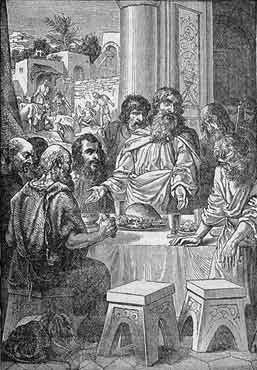
Second Sunday After PentecostGOSPEL (Luke XIV. 16-24.) At that time, Jesus spoke to the Pharisees this parable: A certain man made a great supper,and invited many. And he sent his servant, at the hour of supper, to say to them that were invited, that they should come, for now all things are ready. And they began all at once to make excuse. The first said to him: I have bought a farm, and I must needs go out, and see it; I pray thee hold me excused. And another said: I have bought five yoke of oxen, and I go to try them; I pray thee hold me excused. And another said: I have married a wife, and therefore I cannot come. And the servant returning, told these things to his lord. Then the master of the house being angry, said to his, servant: Go out quickly into the streets and lanes of the city, and bring in hither the poor, and the feeble, and the blind, and the lame. And the servant said: Lord, it is done as thou hast commanded, and yet there is room. And the Lord said to the servant: Go out into the highways and hedges, and compel them to come in, that my house maybe filled. But I say unto you, that none of these men that were invited shall taste of my supper.

What as to be understood by this great supper?

The Church of Christ on earth, in which His doctrine and His most precious Flesh and Blood are given as food to those who belong to her; also the Church triumphant in heaven, in which God Himself, in the beatific vision, is the nourishment. This supper is called great, because God Himself has founded the Church; because the Church embraces heaven and earth, hence many belong and will belong to her; and because having ended the contest on earth, she will last forever in heaven. There the saints of God will enjoy the Highest Good for all eternity, and will have nothing to wish for, since all their desires will there be realized. O, what happiness it is that we are invited to His supper, and as guests are nourished by the teachings of Christ, and by His most sacred Flesh and Blood.

Who is it that prepares the super?

It is Christ, the God?Man, who for our benefit has not only instituted His Church to which He has entrusted doctrine and the Sacrament of His Flesh and Blood, but has gained eternal salvation for us by His passion and death, and who has invited us first by the prophets, who foretold Him and His divine kingdom, and afterwards by His apostles, and their successors to His great supper.

Who are they who excuse themselves?

They are principally the Jews who bound by pride and avarice to earthly possessions, and blinded by the pleasures of the world, did not recognize Jesus, and remained outside of His church. By him who said he had bought a farm are understood those who by constant anxieties about the possession of earthly goods, and the riches of this world, become indifferent to eternal salvation. By him who had bought five yoke of oxen, is to be understood that sort of busy men who are so burdened with worldly affairs that they find no time to work for heaven, for they even appropriate Sundays and festivals to their worldly affairs. By him who had. taken a wife, and could not come, are represented the carnal, impure men who have rendered themselves by their lusts incapable of spiritual and heavenly joys. Since these different classes of people do not wish to have part in the heavenly banquet, God has excluded them and called others.

Who are meant by the poor, the feeble, the blind and the lame?

The humble and submissive Jews, the publicans, also the Samaritans and the Gentiles, who did not reject Jesus and His doctrine as did the proud, high-minded, carnal Scribes and Pharisees to whom Jesus spoke this parable. The former faithfully received Him, entered His Church, and became participators in eternal happiness. This is daily repeated, because God excludes from the kingdom of heaven those proud, avaricious, and carnal Christians who are ever invited by His servants, the priests, to the enjoyment of holy Communion, but who reject the invitation. On the contrary God welcomes the poor, despised people, the penitent sinners, by separating them from the love of the world by the inspiration of His grace, and by the adversities which He sends them. Thus, in a measure, He forces them to take part in the spiritual joys of a sincerely pious life in His Church on earth, and in the heavenly bliss of His Church in heaven.

SUPPLICATON I thank Thee, O most merciful Jesus that Thou bast called me into Thy Church, permitting me sc often to share in the banquet of Thy love, and that by Thy sufferings and death Thou hast obtained the joys of heaven for me. Urge me as seems pleasing to Thee, compel me by temporal trials that by the use of these graces I may obtain the place which Thou bast prepared for me in heaven.

MORAL LESSON CONCERNING THE VICE OF IMPURITY

I have married a wife, and therefore I can not come. (Luke XIV. 29.)

From this foolish excuse it would seem as if married life were an obstacle to arriving at the heavenly banquet, whereas lawful, chaste, Christian marriage is, on the contrary, a means of eternal salvation for those to whom the gift of continency is not given. The excuse of this married man was not grounded on his station in life, but on his inordinate inclination for carnal pleasures which render the one who gives way to it, unfit for spiritual or heavenly things, for the sensual man perceiveth not the things that are of the Spirit of God. (I Cor. II. 14.)

Unfortunate indeed are they who suffer themselves to be carried away by their sensual lusts, who give away the priceless jewel of chastity and purity of heart which makes man equal to the angels, (Matt. XXII. 30.) who for a momentary enjoyment of sinful pleasure lose that white and precious garment in which chaste souls will shine for ever in heaven before the face of God! What benefit does the impure man derive from the gratification of vile lust? He gains the anger and contempt of God; intolerable disgust when the sin is consummated; the torment of a remorseful conscience, and unless he repent, the eternal torments of hell, for the apostle says: Do not err: neither fornicators, nor adulterers, nor the effeminate shall possess the kingdom of God, (I Cor. VI. 9, 10.) It is seen from the examples of the Old Law, hove much God hates and abominates the sins of impurity. Why did God regret having created man? (Gen. VI. 6.) , Why did He destroy all except a very few, by a universal deluge? (Gen. VI. 17.) Why did He lay the cities of Sodom and Gomorrha in ashes by pouring upon them fire and brimstone? (Gen. XIX.) Why did He punish the two brothers Her and Onan, by a sudden death? (Gen. XXXVII. 7. 10.) Why did He permit the whole tribe of Benjamin to be extirpated? (Judges XX.) Because of their detestable sins of impurity. And is not this vice an object of the just wrath of God? By these sins an impure man disgraces his body which should be a member of Christ, a temple of the Holy Ghost; he disgraces his soul the image of God, purified and purchased by the precious blood of Christ, and lowers himself beneath the animal, which, void of intellect, follows its instinct; he weakens the power of his body and soul, and ruins his health; he loses the respect of the good, scandalizes his fellowmen, voluntarily separates himself from the communion of saints, deprives himself of the sanctifying grace of God and participation in the merits of Jesus and His saints, and, if he continues like an animal to wallow in this vice, he finally falls into such blindness and hardness of heart that eternal truths, death, judgment, hell, and eternity no longer make any impression upon him; the most abominable crimes of impurity he considers as trifles, as human weaknesses, no sin at all. He is therefore but seldom, if ever, converted, because the evil habit has become his second nature, which he can no longer overcome without an extraordinary grace from God. This God seldom gives, because the impure man generally despises ordinary means and graces, and therefore despairs and casts himself into the pool of eternal fire, where the worm dies not, and where with Satan and his angels the impure shall be for ever tormented.

Do not suffer yourself to be deceived, Christian soul, by the words "love and friendship", which is sought to cover this vice and make it appear a weakness clinging to man. This impure love is a fire which has its origin in hell, and there it will eternally torment the bodies in which it has prevailed. That which God so much detests and so severely punishes, certainly cannot be a trifle, a human weakness! Impress deeply on your heart that all impure thoughts, desires and looks, to which you consent, all impure words, songs, exposures, touches, jokes, and 'such things, are great sins which exclude you from the kingdom of heaven, into which nothing defiled can enter. Remember that he who looks at a woman with a lustful desire, has already, as Christ says, committed adultery in his heart. (Matt. V. 28.) We must, then, carefully guard against "such trifles", as the wicked world calls them, if we do not wish to expose ourselves to the greatest danger of losing our souls. Although it is difficult for an impure person to be converted, yet he should not despair. God does not cast away even the greatest sinner; Jesus forgave the adulteress in the temple, and forgave and received Mary Magdalen. But he who wishes to repent must make use of the proper means to regain the grace of God, and prevent a relapse. Those who have not defiled themselves by the sin of impurity can make use of the following means:

  1. Constant prayer. Hence the admonition of the wise King; As I knew that I could not otherwise be continent, except God gave it, I went to the Lord and besought him. (Wisd. VIII. 21.)

  2. Mortification of the flesh by fasting and abstinence. Jesus says these impure spirits can in no other way be cast out but by prayer and fasting. (Matt. XVII. 20.)

  3. The frequent meditation on the four last things, and on the bitter sufferings of our Lord; for there is, says St. Augustine, no means more powerful and effective against the heat of lust than reflection on the ignominious death of the Redeemer.

  4. The quiet consideration of the temporal and eternal evils which follow from this vice, as already described.

  5. The love and veneration of the Blessed Virgin who is the mother of beautiful love, the refuge of all sinners, of whom St. Bernard says: "No one has ever invoked her in his necessity without being heard."

  6. The careful mortification of the eyes. The pious Job made a covenant with his eyes, that. he would not so much as look upon a virgin. (Job XXXI. 1.)

  7. The avoidance of evil occasions, especially intercourse with persons of the other sex. "Remember," says St. Jerome, "that a woman drove out the inhabitants of paradise, and that you are not holier than David, stronger than Samson, wiser than Solomon, who all fell by evil intercourse."

  8. The avoidance of idleness: for idleness, says the proverb, is the beginning of all evil.

  9. The immediate banishing of all bad thoughts by often pronouncing the names of Jesus and Mary, which, as St. Alphonsus Ligouri says, have the special power of driving away impure thoughts.

  10. The frequent use of the holy Sacraments of Penance and of the Altar. This last remedy in particular is a certain cure if we make known to our confessor our weaknesses, and use the remedies he prescribes. The Scripture says that frequent Communion is the seed from which virgins spring, and the table which God has prepared against all temptations that annoy us.

COLLECT Inflame, O Lord, our loins and hearts with the fire of Thy Holy Spirit, that we may serve Thee with pure bodies, and please Thee with clean hearts. Amen.